group <- c("Vaccinated", "Unvaccinated")
cases <- c(5, 25)
population <- c(500, 500)
risk <- cases / population
barplot(
risk,
names.arg = group,
col = c("steelblue", "tomato"),
main = "Risk of Infection by Vaccination Status"
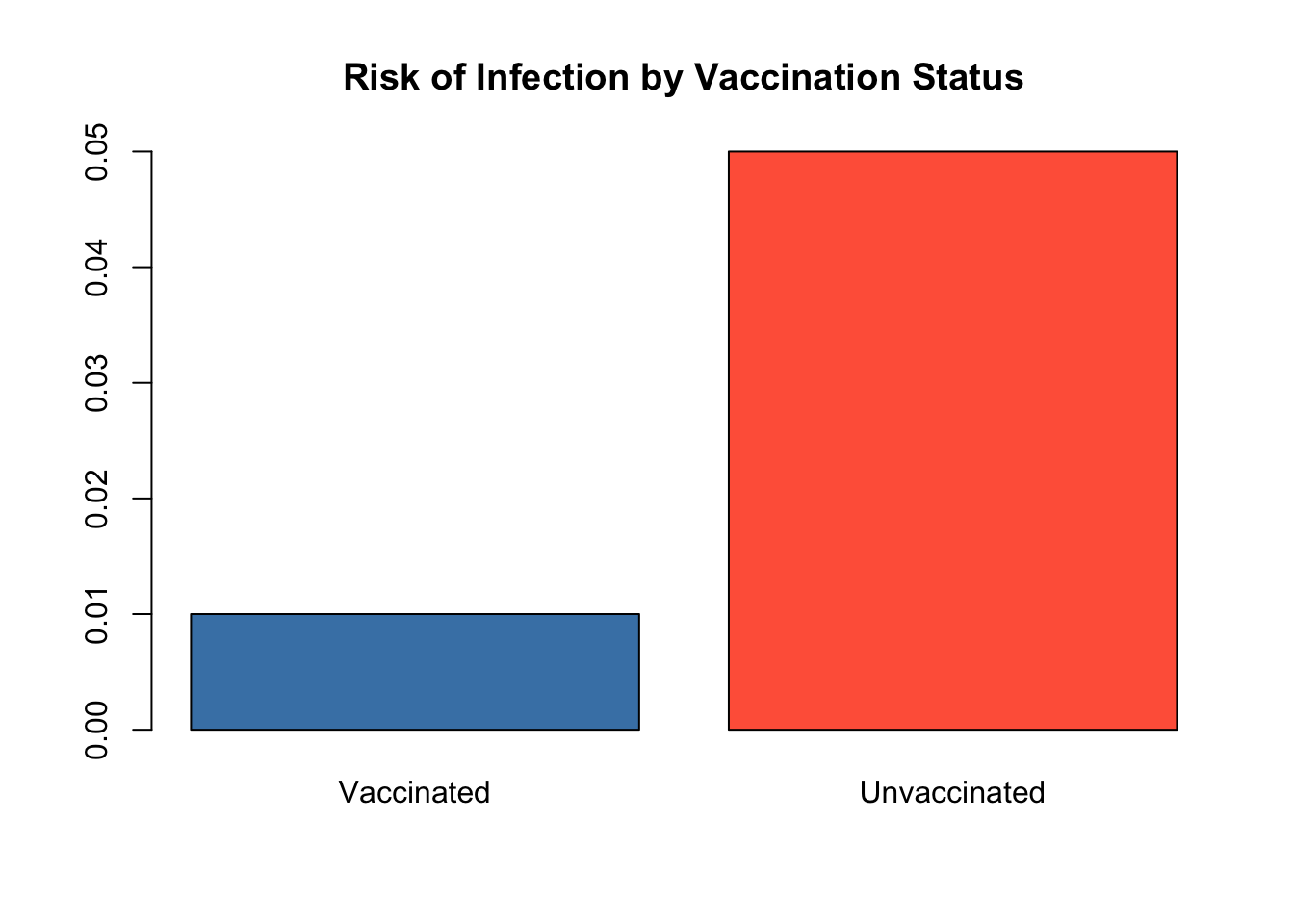
)
Vaccine effectiveness measures the reduction in disease risk among vaccinated individuals compared to unvaccinated individuals in real-world conditions.
Calculate risk in the vaccinated group: 5 / 500 = 0.01
Calculate risk in the unvaccinated group: 25 / 500 = 0.05
Relative Risk = 0.01 / 0.05 = 0.2
VE = (1 − 0.2) × 100 = 80%
Why might vaccine effectiveness differ between populations?
Differences in exposure, population structure, healthcare access, and underlying health conditions can influence estimates.
group <- c("Vaccinated", "Unvaccinated")
cases <- c(5, 25)
population <- c(500, 500)
risk <- cases / population
barplot(
risk,
names.arg = group,
col = c("steelblue", "tomato"),
main = "Risk of Infection by Vaccination Status"
)
group <- c("Vaccinated", "Unvaccinated")
cases <- c(5, 25)
population <- c(500, 500)
risk <- cases / population
barplot(
risk,
names.arg = group,
col = c("steelblue", "tomato"),
main = "Risk of Infection by Vaccination Status"
)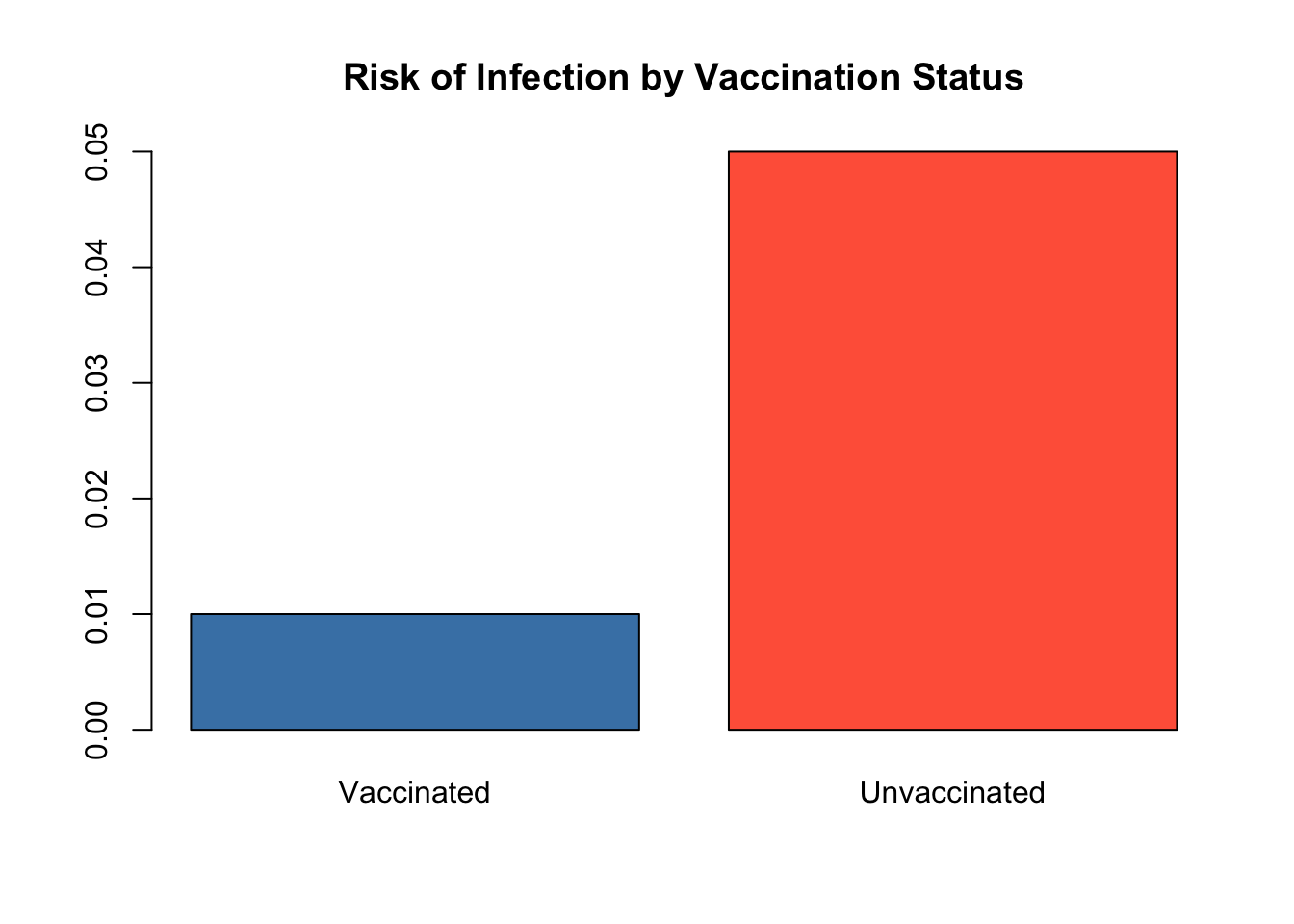
An 80% vaccine effectiveness means vaccinated individuals have substantially lower risk compared to unvaccinated individuals.
The calculation assumes both groups are comparable and equally exposed.
Confounding factors such as age, immunity, or healthcare access may influence results.
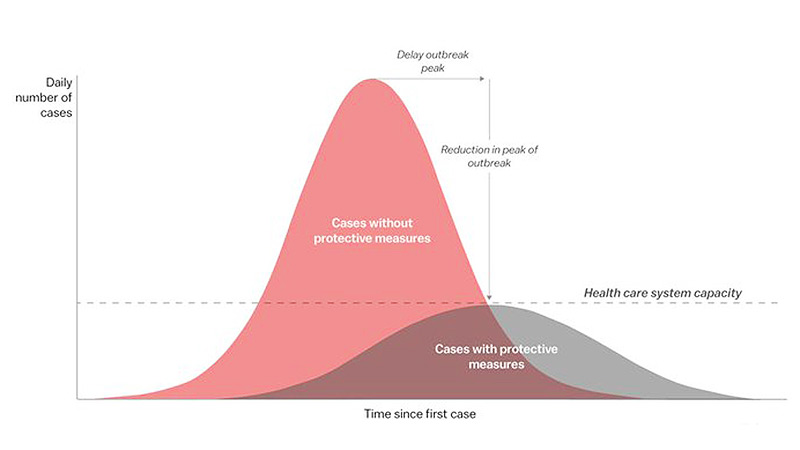
Based on the outbreak data, what does a vaccine effectiveness of 80% mean in practice?
Select one answer.
Explanation:
Vaccine effectiveness compares the risk of disease in vaccinated and unvaccinated groups under real-world conditions. An 80% VE means the vaccinated group experienced substantially lower risk, not that infection risk was eliminated entirely.
Vaccination significantly reduces the likelihood of infection and severe disease, even if it does not eliminate risk entirely.
\[(x + a)^{n} = \sum_{k = 0}^{n}{\binom{n}{k}x^{k}a^{n - k}}\]
Display equation example
\[ P(X=x)=\binom{n}{x}p^x(1-p)^{n-x} \]